Open documentation is a navigation system for machines as well as people.
GitHub Docs exposes a useful pattern: structured content can remain human-facing while also becoming programmatically addressable.
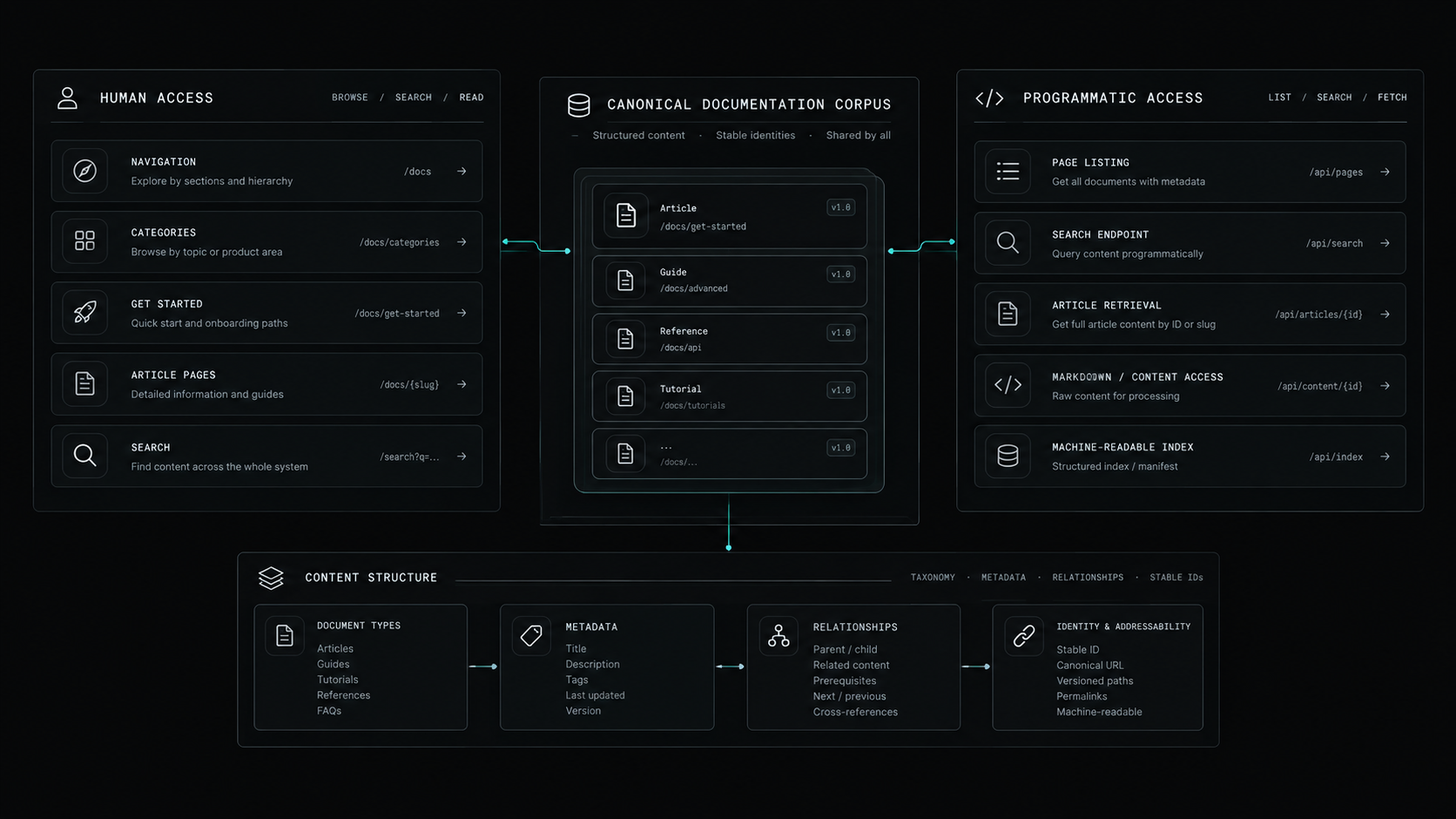
A knowledge system becomes more useful when its content has more than one legitimate path into it. The important distinction is between duplicating content for different machines and structuring the same content so it can be addressed in different ways.
Research question
What does a mature documentation system expose so the same knowledge remains useful to both human readers and programmatic clients?
Scope
This review examines the current GitHub Docs programmatic-access documentation, with attention to its article endpoint, page listing, search, and llms.txt references. The focus is not AI optimization; it is whether a durable documentation system exposes predictable ways to retrieve the same underlying knowledge.
The review was conducted on September 11, 2026.
Finding 01 — The content model remains the same knowledge system
GitHub's documentation API describes endpoints for listing pages, searching documentation, and retrieving individual article content as Markdown. The documentation also points to llms.txt for content discovery.
The important observation is that these are alternate access paths to an existing documentation corpus, not a separate set of machine-only pages.
That is a stronger architectural pattern than duplicating “human” and “machine” versions of the same article. One durable content source can support multiple interfaces when the underlying records have stable identities and predictable structure.
Finding 02 — Addressability improves reuse
An article that can be addressed by a stable pathname can become useful in more than one context: direct human navigation, search, tooling, indexing, or programmatic retrieval. GitHub's API documentation makes that relationship explicit by accepting an article pathname and returning its content and metadata.
This is not evidence that every site needs an API. It is evidence that structured content creates options. A loosely assembled collection of rendered pages has fewer reliable ways to expose the same knowledge.
Finding 03 — Human-first structure remains necessary
The same GitHub Docs corpus still provides conventional navigation, categories, get-started paths, and article pages. Programmatic access sits alongside those surfaces instead of replacing them.
The implication is straightforward: machine addressability works best as a property of a well-structured content system, not as an excuse to distort the public reading experience.
Interpretation
The evidence suggests that “machine discoverability” is less interesting as an optimization tactic than as an architectural quality. Stable URLs, clear content objects, explicit navigation, and predictable metadata make a knowledge system easier to consume through more than one interface.
That is an inference from the documented structure, not a claim about ranking, referral volume, or AI citation frequency.
The best machine-readable research system is usually the same well-structured knowledge system humans already want to use.
Implications for public knowledge systems
The architectural implication is straightforward: a well-structured knowledge system does not need separate human and machine versions of the same information. Stable article URLs, explicit organization, structured metadata, and predictable access paths allow the same underlying content to serve multiple contexts.
That does not mean every documentation system needs an API. It means machine access becomes easier when the underlying information has already been modeled as durable content rather than as disconnected rendered pages.
Related research
That is an inference from the documented structure, not a claim about ranking, referral volume, or AI citation frequency.
Looking for a specific architecture?
Browse the current website catalog, or join the network for one email when a new architecture publishes. Nothing else.