Pricing pages are product architecture surfaces.
A comparative reading of Stripe and Linear shows that pricing pages communicate system structure before they communicate price.
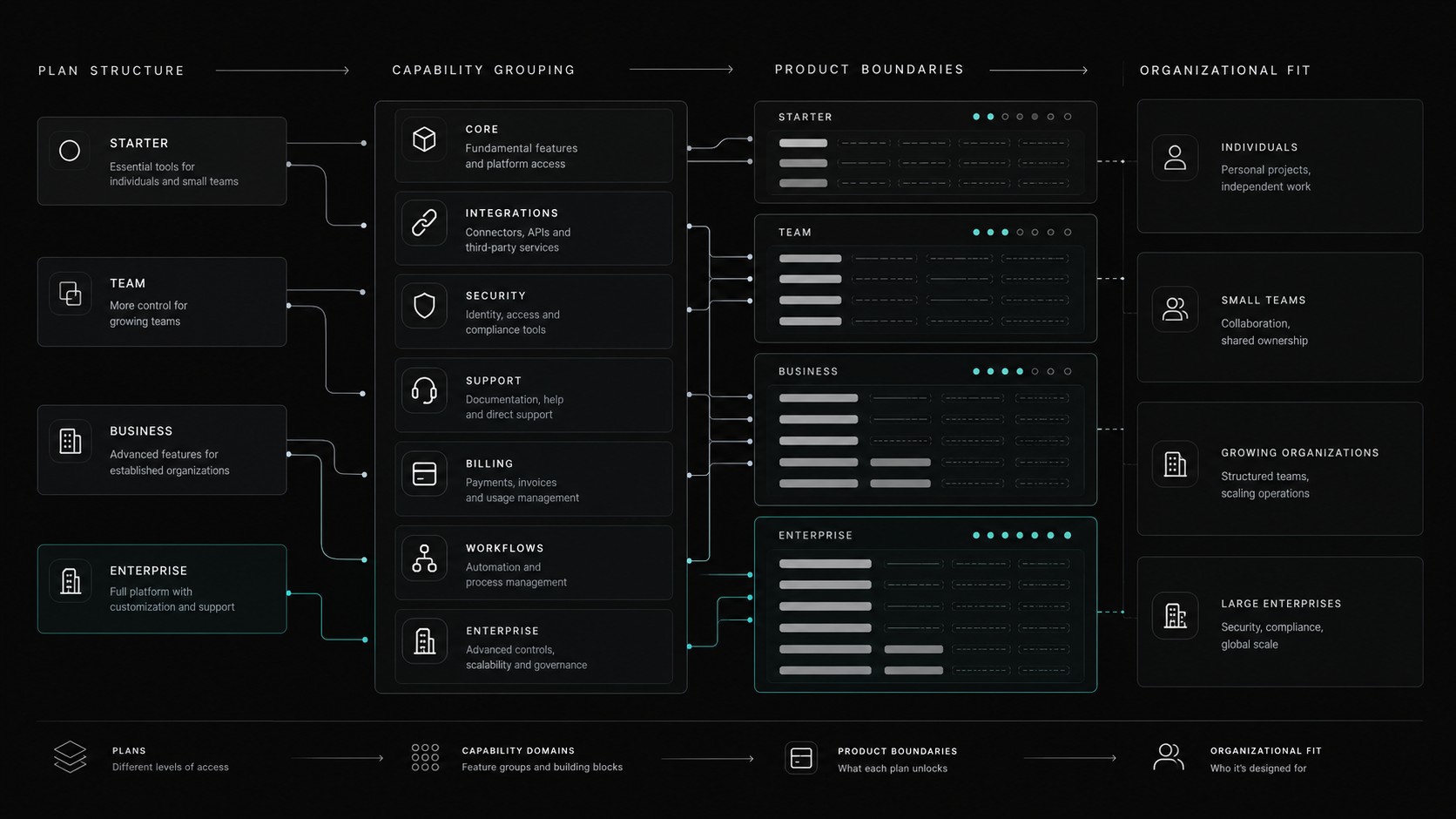
A pricing page is often treated as the last commercial step before purchase. In practice, the structure of the page can explain the product long before a visitor decides whether to buy.
Research question
What does a well-structured software pricing page communicate besides price?
Scope
This review compares the public pricing structures of Stripe Billing and Linear. The focus is the information architecture of the plans and feature comparison rather than the absolute attractiveness of their prices.
The review was conducted on September 11, 2026. Pricing and packaging are time-sensitive; the observations should be read as a snapshot of the public pages on that date.
Finding 01 — Plan names establish product boundaries
Stripe separates its Billing offer into pay-as-you-go, pay-monthly, and custom pricing. Linear presents Free, Basic, Business, and Enterprise plans and then compares capabilities across those levels.
In both cases, the plan architecture is doing more than labeling price points. It communicates that the product can be entered through different operating models and that some capabilities belong to specific organizational needs.
That is an observation about page structure, not a claim about why buyers ultimately choose one plan over another.
Finding 02 — Feature comparisons explain the system's internal model
Linear's comparison table groups capabilities into areas such as Core, AI and agent workflows, Integrations, Security, and Support. Stripe's Billing presentation similarly separates capabilities such as selling, billing, collecting, pricing models, and subscription management.
The result is a second layer of product explanation. A visitor can infer which capabilities the vendor considers part of the core system and which appear at higher organizational requirements.
The comparison is especially useful because the information is not expressed as one long feature list. The groupings create relationships between capabilities.
Finding 03 — Commercial architecture can reduce product ambiguity
A visitor evaluating a technical product is often trying to answer two questions simultaneously: “What does this system do?” and “Which version of this system fits my situation?” A pricing page that only gives numbers answers neither completely.
Stripe and Linear demonstrate a more explicit structure: plan level, capability grouping, and eligibility context appear together. The exact implementation differs, but the communication job is similar.
This suggests a useful design principle: pricing architecture can act as a compact explanation of product boundaries when it is organized around meaningful capability differences.
Interpretation
The evidence does not demonstrate a direct conversion effect. It does support a narrower conclusion: mature pricing pages can function as product maps because the plan boundaries expose how capabilities are grouped and who they are intended to serve.
That distinction matters for technical products. If the underlying product has meaningful capability boundaries, hiding those boundaries until after purchase or inside documentation forces the visitor to construct the model alone.
When plan structure mirrors product structure, the pricing page becomes part of the product explanation rather than a page that merely names a number.
Implications for product websites
A useful pricing page should make the differences between plans inspectable without requiring a reader to memorize marketing language. That usually means:
- naming plans according to real product boundaries;
- grouping capabilities by understandable system areas;
- making important eligibility differences visible;
- and separating commercial signals from unsupported performance promises.
For Velox research, the more interesting future question is not “which pricing page converts better?” but “which structural choices make a complex product easier to evaluate?” That is answerable through a defined comparative study rather than opinion.
Related research
A more useful future question is not ‘which pricing page converts better?’ but ‘which structural choices make a complex product easier to evaluate?
Looking for a specific architecture?
Browse the current website catalog, or join the network for one email when a new architecture publishes. Nothing else.