A technical website needs a navigation model before it needs more pages.
What a comparative review of mature technical documentation systems reveals about structure, not volume.
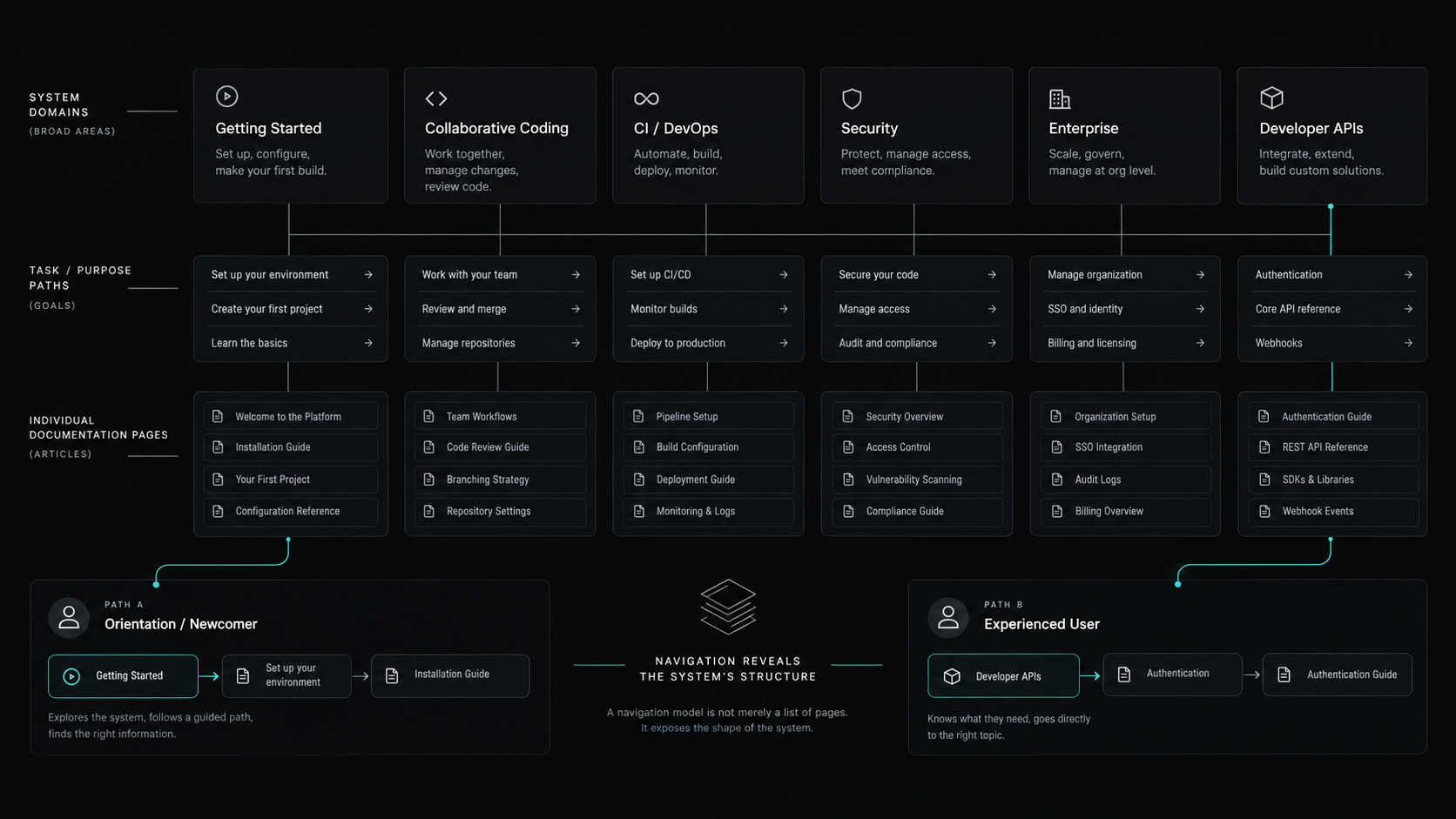
A technical website is easy to make busy. It is harder to make legible. The difference is rarely the number of pages. It is whether the visitor can build a mental model of the system from the way those pages are arranged.
Research question
What does a technical knowledge system need to expose before a visitor can productively choose a path through it?
Scope
This review looks at the public information architecture of GitHub Docs and compares it with the navigation logic visible across the surrounding GitHub product documentation. The observation is structural rather than a usability score: what kinds of paths are exposed, how those paths are grouped, and what the system asks the reader to understand before choosing a page.
The review was conducted on September 11, 2026. It is a snapshot of the public documentation experience, not a claim about every GitHub surface.
Finding 01 — Navigation is doing explanatory work
The GitHub Docs home does not begin with a flat list of articles. It exposes broad areas such as getting started, collaborative coding, CI/CD and DevOps, security and code quality, client apps, project management, enterprise and teams, and developer APIs. Those groupings are already a compressed model of the product surface.
That distinction matters. A page list answers “what exists?” A navigational model begins to answer “how does this system break down?”
The observation is not that every technical website needs GitHub's categories. It is that navigation can carry domain structure. When the structure is explicit, the reader can choose a starting point without already knowing the product vocabulary.
Finding 02 — A useful hierarchy has more than one level
GitHub's documentation also moves from broad areas into task-oriented collections and then into individual articles. Its “Get started” section is not simply another archive; it provides a sequence for new readers while the larger documentation index continues to expose the wider system.
This creates two paths through the same knowledge base: orientation for a newcomer and direct access for an experienced reader.
That is a useful distinction for technical websites generally. One navigation layer answers “where should I begin?” while another answers “where is the thing I already know I need?” Combining both into one undifferentiated menu forces one audience to navigate for the other.
Interpretation
The evidence suggests that information architecture is part of technical communication, not merely a container for it. A visitor does not encounter the product only in the prose of individual pages. They encounter it in the boundaries and relationships the navigation makes visible.
This is an inference from the observed structure, not a measured conversion result. It does not establish that GitHub's architecture is optimal for every product. It does show that a mature documentation system can make a product model visible before the reader opens a detailed page.
The first useful page in a technical knowledge system may be the map that explains why the other pages are grouped the way they are.
Implications for technical websites
A smaller product site does not need a documentation tree with dozens of sections. It does need enough structure to answer three practical questions:
- What are the major areas of the system?
- Which path is appropriate for someone who is new?
- How can an experienced reader get directly to a known topic?
The implementation consequence is deliberately modest: establish durable areas, make their purpose legible, and let article count follow real knowledge rather than determine the navigation.
What to measure next
For a future first-party study, the useful next step is not to count how many links a documentation site contains. It is to compare how often visitors can move from a broad area to a specific task without crossing unrelated conceptual boundaries.
That would require a defined sample and observation method rather than a casual benchmark, so it is intentionally left as future work.
Related research
The next useful questions are how documentation search, task completion paths, and page-level product explanations interact as a technical knowledge system grows.
Looking for a specific architecture?
Browse the current website catalog, or join the network for one email when a new architecture publishes. Nothing else.